
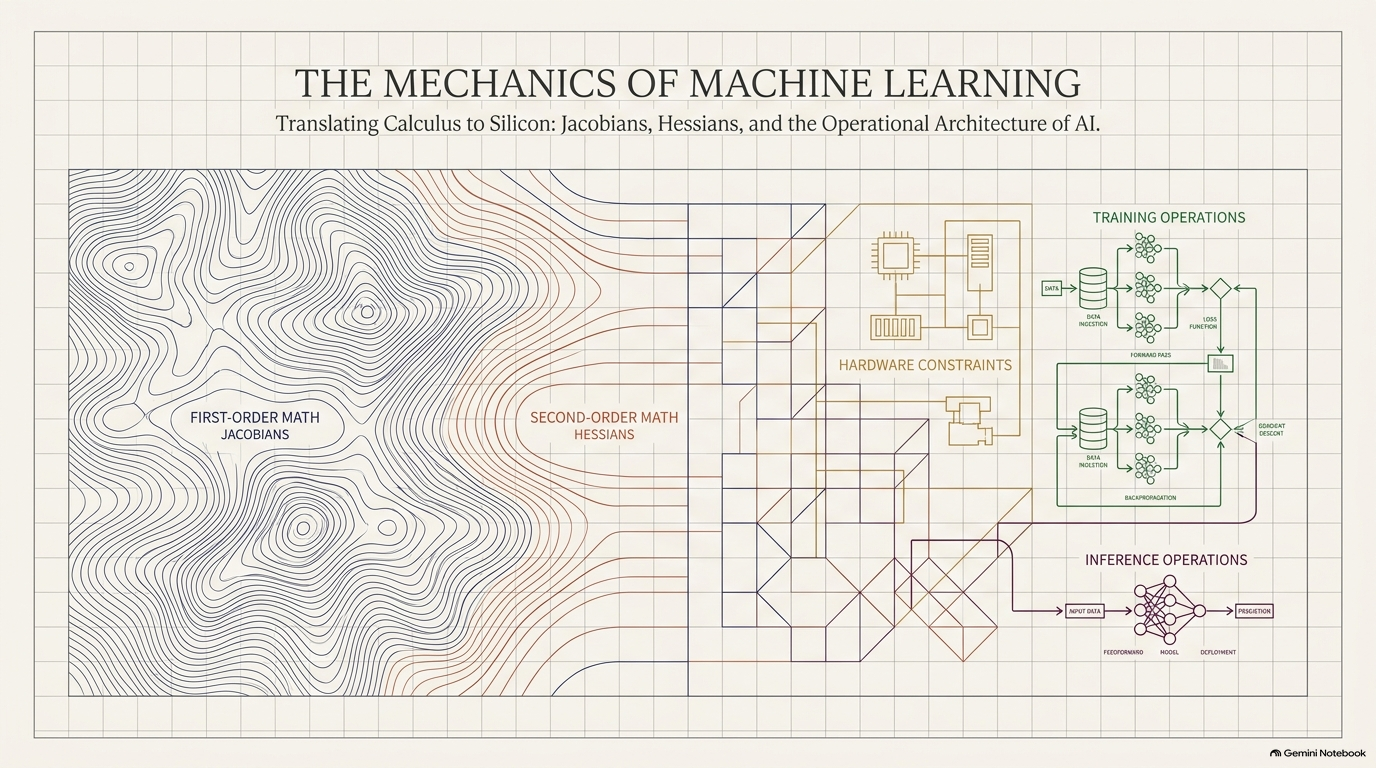
The Mechanics of Machine Learning
Translating calculus to silicon — Jacobians, Hessians, and the operational architecture of AI.
Beyond the Single Derivative
Standard calculus answers a simple question: if I nudge x, how much does y change? Neural networks need a lot more than that.
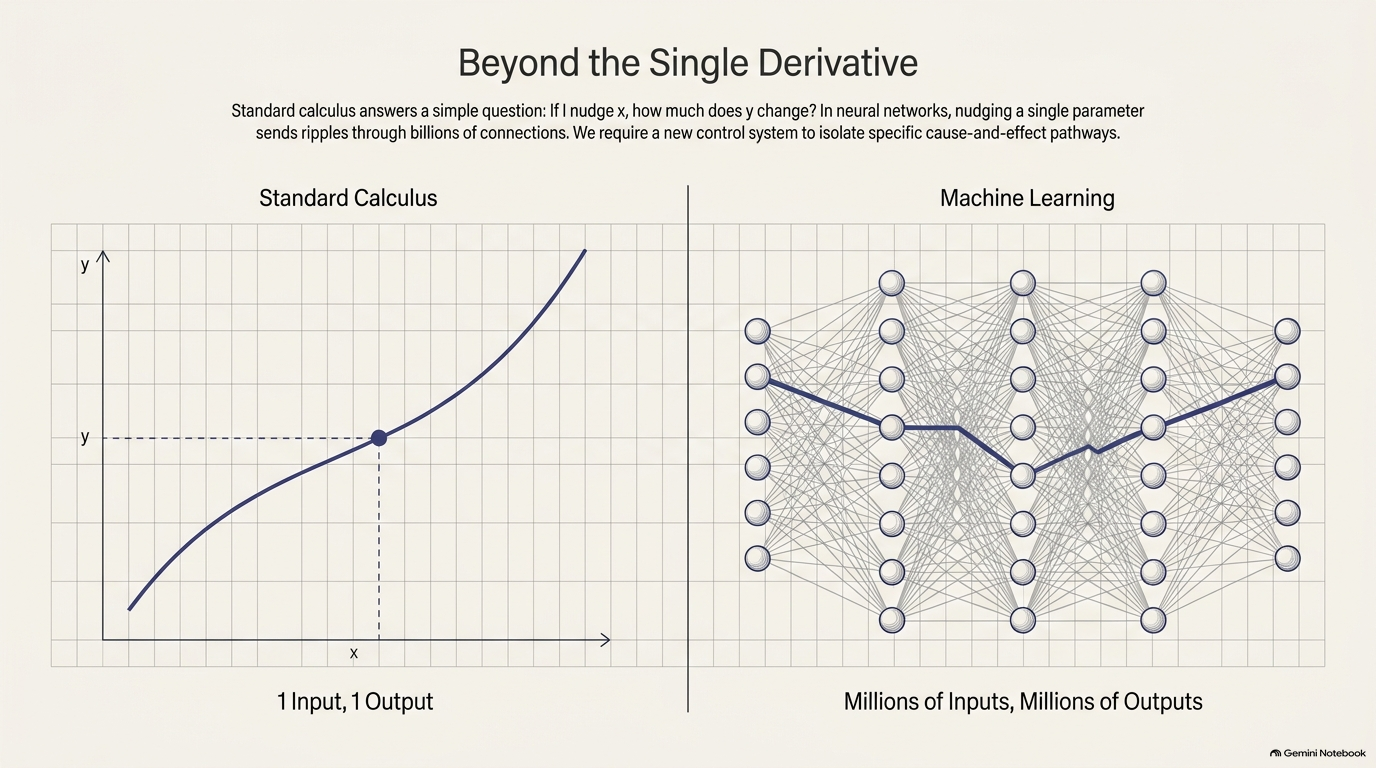
Standard Calculus
One input, one output. A single derivative traces one curve — nudge x, read the corresponding change in y.
Machine Learning
Millions of inputs, millions of outputs. Nudging a single parameter sends ripples through billions of connections — a new control system is required to isolate specific cause-and-effect pathways.
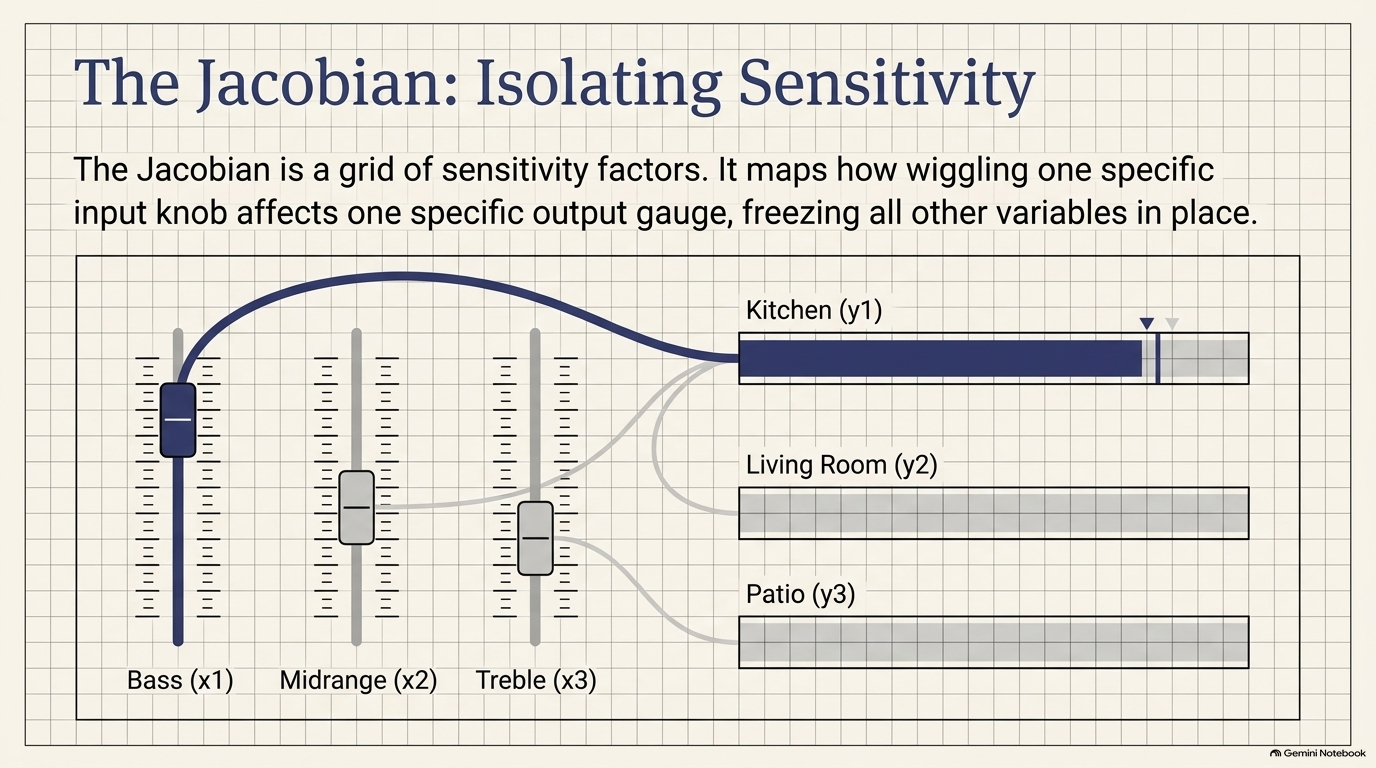
The Jacobian: Isolating Sensitivity
A grid of sensitivity factors — how wiggling one input knob affects one output gauge, with every other variable frozen in place.
Assembling the Jacobian Matrix
Instead of recalculating complex equations from scratch, multiply simultaneous input changes by this matrix to predict every output change instantly.
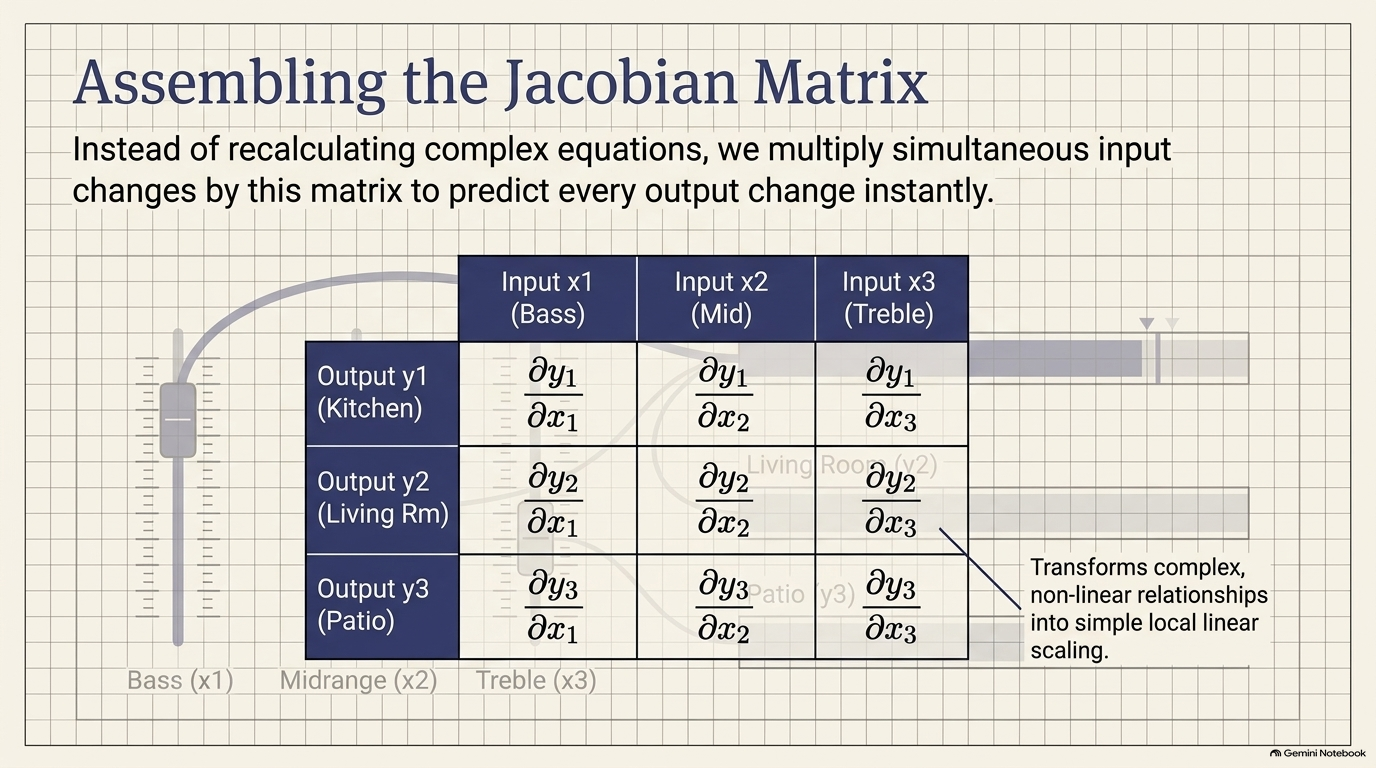
| Input x1 (Bass) | Input x2 (Mid) | Input x3 (Treble) | |
|---|---|---|---|
| Output y1 (Kitchen) | ∂y1/∂x1 | ∂y1/∂x2 | ∂y1/∂x3 |
| Output y2 (Living Rm) | ∂y2/∂x1 | ∂y2/∂x2 | ∂y2/∂x3 |
| Output y3 (Patio) | ∂y3/∂x1 | ∂y3/∂x2 | ∂y3/∂x3 |
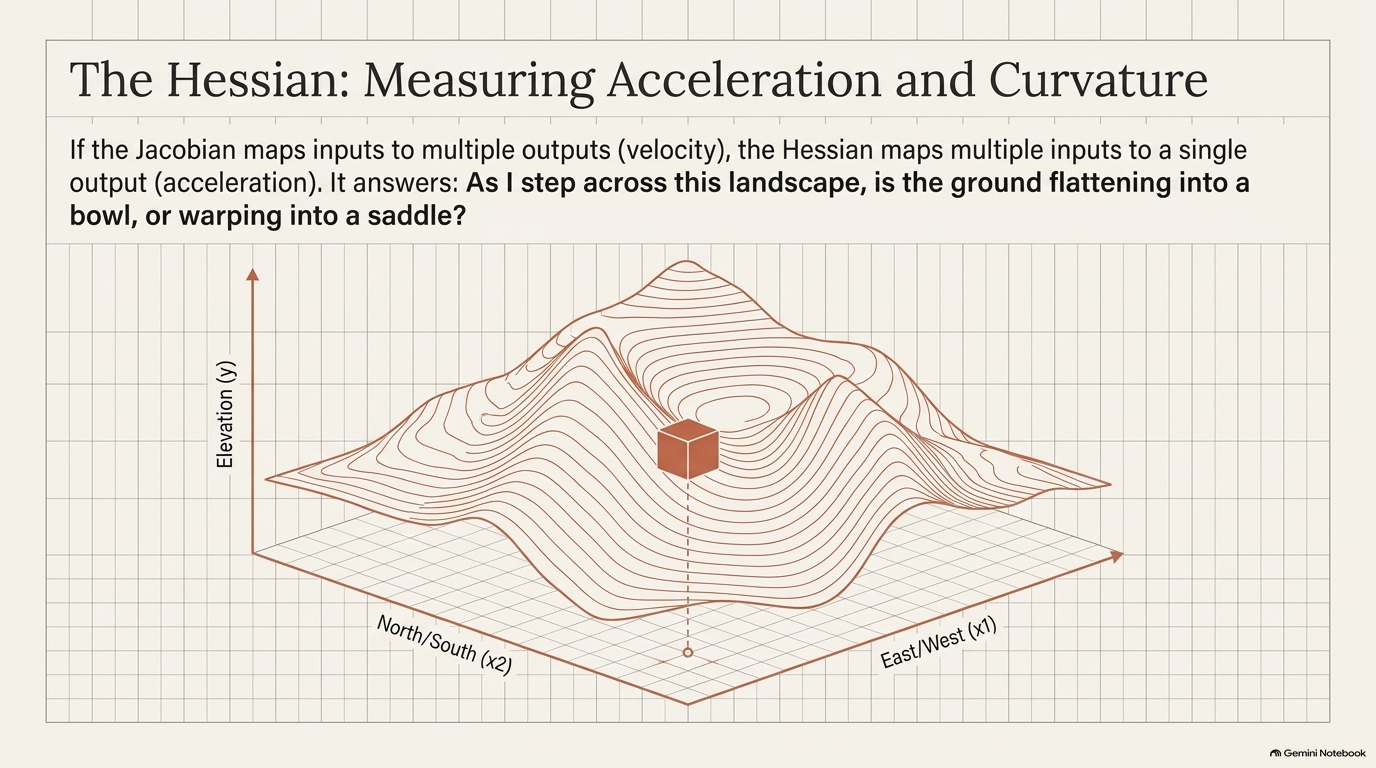
The Hessian: Measuring Acceleration and Curvature
If the Jacobian maps inputs to multiple outputs (velocity), the Hessian maps multiple inputs to a single output (acceleration).
Decoding the Second Derivative
The Hessian isolates two critical dynamics: diminishing returns along a single axis, and how two separate inputs amplify or interfere with each other.
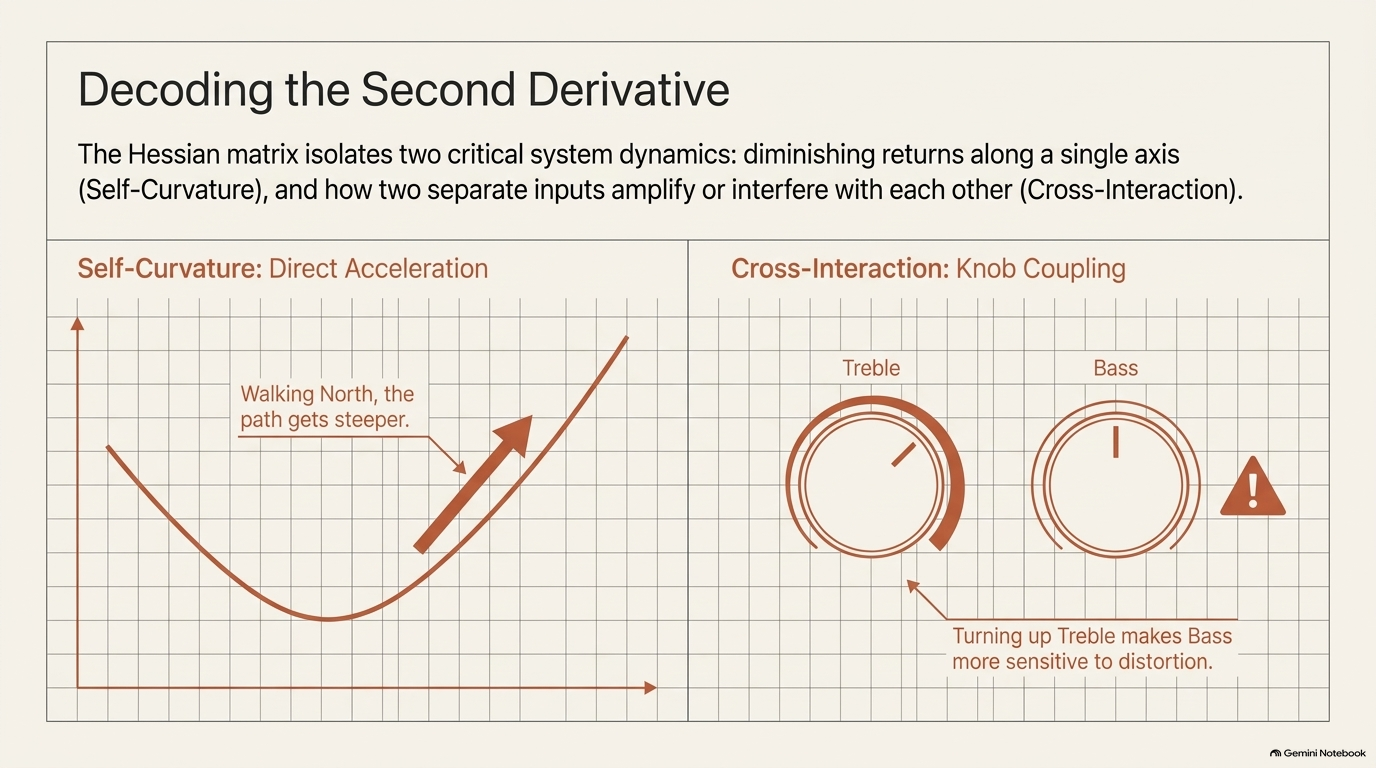
Self-Curvature: Direct Acceleration
Walking along one axis, the path itself gets steeper or flatter — the diagonal entries of the Hessian, measuring how a single input's own effect accelerates.
Cross-Interaction: Knob Coupling
Turning up Treble can make Bass more sensitive to distortion. The off-diagonal entries capture exactly this: how moving one input changes the sensitivity of another.
Synthesis: Navigating the Loss Valley
To minimize error, an ML system must find the valley floor — the Jacobian steers, the Hessian paces.
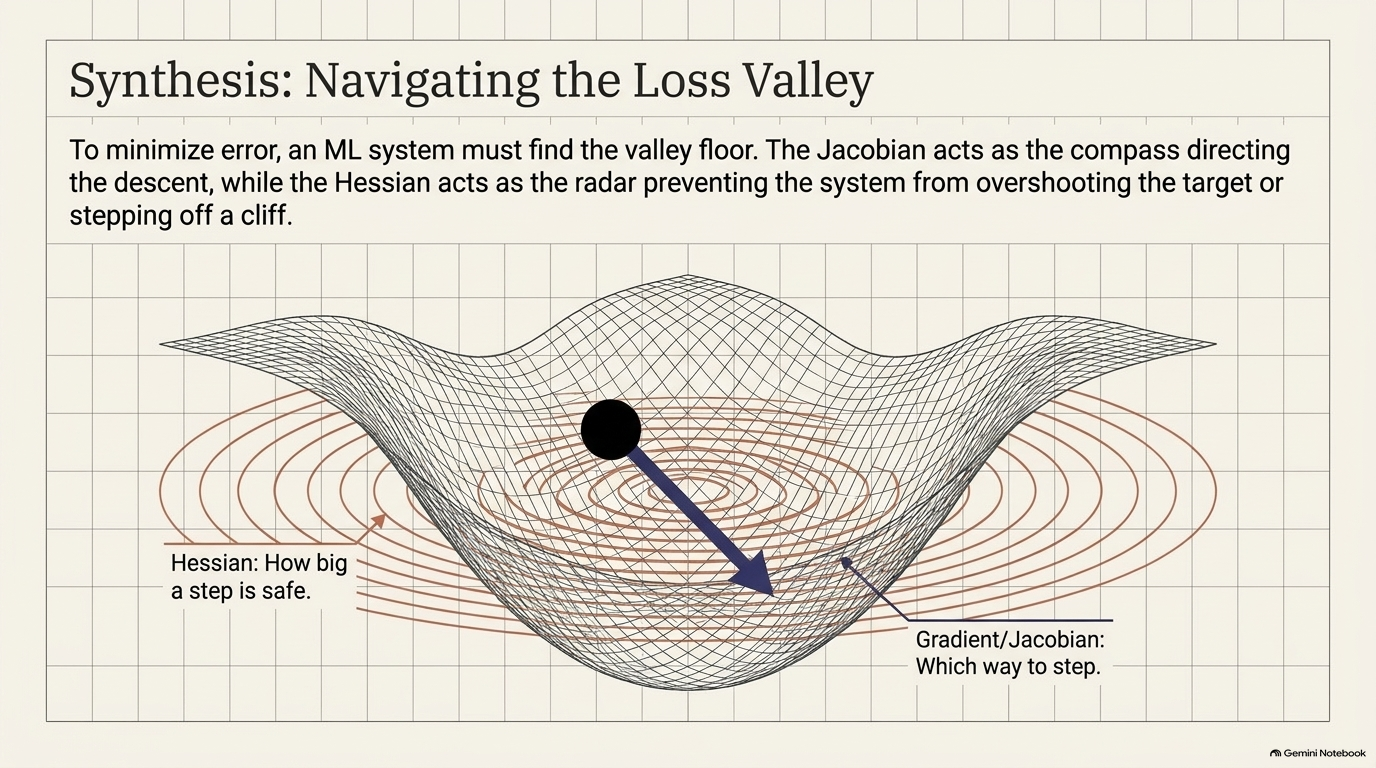
Gradient / Jacobian
Acts as the compass, directing the descent — which way to step to reduce the loss.
Hessian
Acts as the radar, preventing the system from overshooting the target or stepping off a cliff — how big a step is safe.
The Derivative Diagnostic
A structural comparison of first- and second-order mechanics in multi-variable environments.
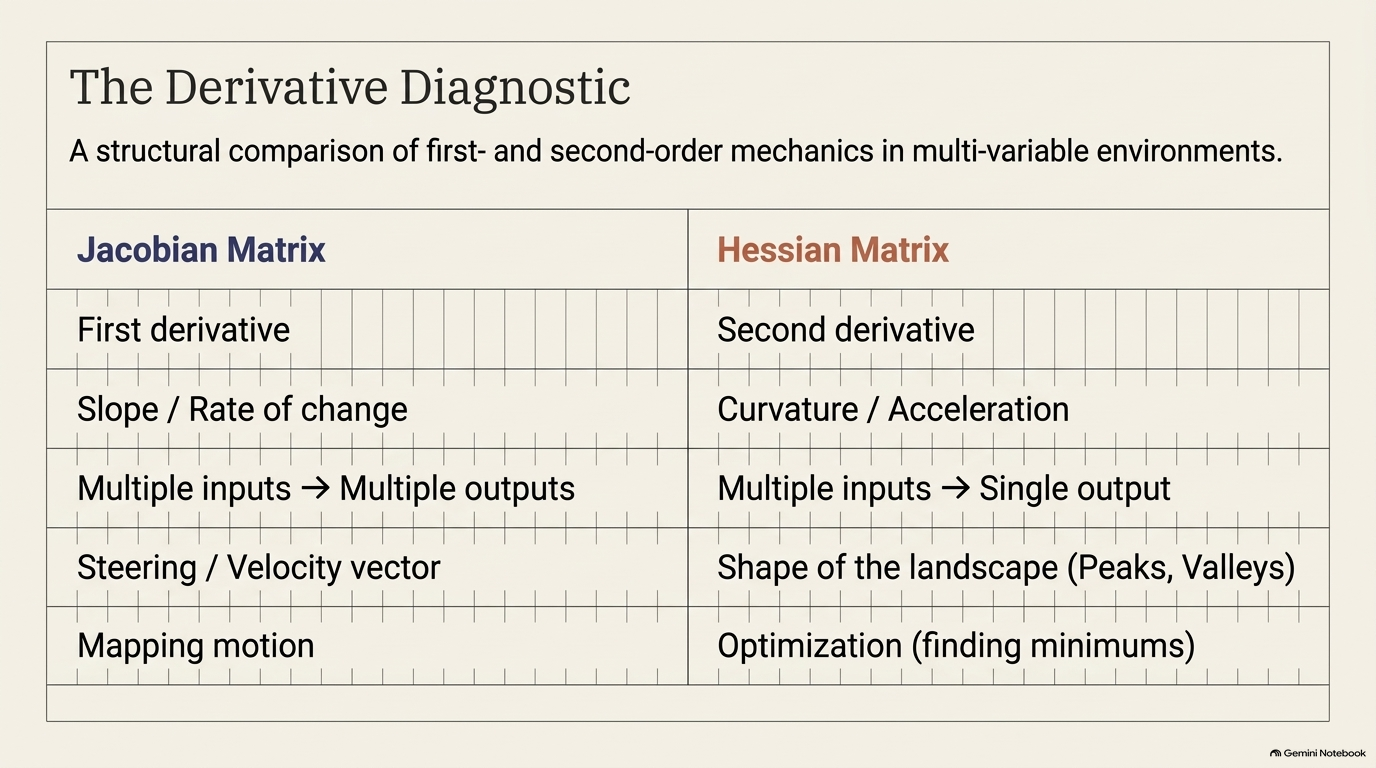
| Jacobian Matrix | Hessian Matrix |
|---|---|
| First derivative | Second derivative |
| Slope / rate of change | Curvature / acceleration |
| Multiple inputs → multiple outputs | Multiple inputs → single output |
| Steering / velocity vector | Shape of the landscape (peaks, valleys) |
| Mapping motion | Optimization (finding minimums) |